Stuff A Computer Programmer In Your Arts Hole

Possible evidence of what I suggested yesterday regarding the need to discuss all the career paths available to arts grads comes in a post last week by Alex Tabbarok Marginal Revolution blog.

Tabbarok opens by reviewing graduation data he used in a book he published showing more students graduated with a bachelor’s degree in visual and performing arts in 2009 than in “in computer science, math and chemical engineering combined.”

So what has happened since 2009? The good news is that enrollment in STEM fields has increased dramatically. The number of graduates with computer science degrees, for example, has increased by 34%, chemical engineering degrees are up by a whopping 49.5% and math and statistics degrees have increased by 32%.

The bad news is that we are still graduating more students in the visual and performing arts than in computer science, math and chemical engineering combined. As I said in Launching nothing wrong with the visual and performing arts but those are degrees which are unlikely to generate spillovers to society.

In the comments section there is a lot of discussion about the relative usefulness of different majors. The following observations about the mix of proficiencies one needs to create a successful product in computer science caught my eye.

Floccina February 4, 2016 at 10:04 am

The CS majors could be made easier. There are hard programming tasks and easy programmings task, there IMO are even programming where less intelligent people can do a better job by making interface that is easier to understand. Some programing task require less intelligence and more art. So perhaps there should be an easy Computer programming major. And perhaps it would make us all better off by increasing total production.

Fill disclosure I am a programmer who not so smart. When I have a difficult algorithm to write that I cannot look up I get help from a smart person.

Andy February 4, 2016 at 11:09 am

I agree. I’m a liberal arts major in English and Information Studies (not programming), and lucked out by finding a job that trained me in administrative computing. CS majors are really needed for software engineering but for programming for basic business processes they can really screw things up, often because their communication skills aren’t that great. The setup we have at my university – train liberal arts majors in computing – has worked well because they draw smart people from areas and occupations that emphasize communication and critical thinking. I’m always hearing horror stories of young CS majors who overengineered systems to the point of unmaintainability and can’t be reasoned with.

An inch below that, someone comments that Apple was able to produce a successful product because Steve Wozinak was a genius at writing effective code and Steve Jobs knew that the user interface needed to be simple and attractive to users.

The problem with Tabbarok’s view, which is generally shared, is that it assumes a computer science major gets plugged into a computer science job hole and a psychology major gets plugged into a psychology job hole and if there are no corresponding jobs needing to be plugged into, then those majors are useless.

This ignores the fact that the value of computer programs, chemicals, medicine, etc., don’t become self-evident upon creation. Like it or not, marketing, advertising and design communicate something that draws attention and causes people to value those items. Whether that thing deserves to be valued is another conversation altogether.

Would you have even known of the existence of the original Macintosh 128k, much less wanted to buy the boxy thing if it weren’t for the iconic 1984 Super Bowl ad? Why did VHS trump Beta when the latter was the superior format? Acai berries always had the same nutritional qualities so why were they miracle berries one year and barely mentioned the next?

The value of something isn’t completely dependent or proportionate to its usefulness.

From a certain point of view, the computer science, chemistry and biology degree really only has value because the creative team at a marketing firm has made the software, artificial sweetener or drug important. Even then, the product may fail for intangible and unexpected reasons just as high budget movies do.

To some degree, more computer science jobs create more creative jobs and creative jobs help create more computer science jobs. This sort of interdependence is illustrated by the success of Amazon, Google and Facebook. Nobody would be hired in one group of jobs if the other area was deficient. (Lord knows, whoever keeps updating the TOS for Facebook has nearly screwed things up a number of times.)

This gets back to what I was saying yesterday. Everyone is done a disservice when they are told actors can only act, violinists can only be in an orchestra, psychologists can only get jobs in clinical, counseling and school psychology.

God help us if a tuba player starts a technology company!

This isn’t to say that there is no value in pursuing a discipline toward a highly specialized end. There is a lot of training, study and practice behind orchestra musicians, surgeons, major league baseball players, ballet dancers, etc. It is widely acknowledged that there are only a few such slots available to the tens to hundreds of thousands of practitioners (except surgeons, of course, I hope there aren’t that many people practicing surgery for fun).

Those who don’t have the ability and will to operate at an elite level shouldn’t have other options closed off to them by a siloing mentality if they have skills that overlap well into other areas.
The Water Balloon War Final Exam

I was listening to some Big Think videos this weekend when I was struck with an insight about educational philosophy. I am pretty sure it isn’t a new insight, but the metaphor that occurred to me might help a little bit with the conception of the problem.

At the tail end of an interview with psychologist Laurence Steinberg, he says that there is no problem with teaching to the test if the test is measuring something that you want kids to achieve.

Sir Ken Robinson and others have pointed out that our goals for education are based in Industrial Revolution thinking where education was meant to create a competent workforce. (Robinson’s words are entertainingly illustrated in the Zen Pencils cartoon I shared last week.)

As Robinson has pointed out elsewhere, we barely know what the world will look like in five years time, much less what skills will be needed in 15-20 years time when students being educated today start to enter the job market.

The thing that struck me, perhaps influenced by the Super Bowl this weekend, was that our current education system is akin to having the evaluation of effectiveness measured by success in a football game at the end of the year.

People complain that the approach is brutal, damaging, favors certain genders, races and physical types (or learning styles in the case of education), and doesn’t really confer the skills required for employment or even college.

The counter example that occurred to me was having a water balloon fight as the end of year evaluation. Even though both football game and a water balloon fight would be informed by history lessons in battle tactics, geometry and physics, a water balloon fight lends itself more widely, creatively and easily.

There are many more lessons to be learned preparing for a water balloon fight about the use of terrain and technology in battles that would bring history alive. With options of hand throwing, catapults, slingshots to launch water balloons, geometry and physics have to be factored in constantly by participants.

Chemistry class can be devoted to investigation of whether adding gelatin changes the ballistic properties of the balloons and whether the stickiness upon explosion will be sufficient to gum up the works of enemy weaponry and thwart hand launching attempts.

Biology class can include investigation of using biodegradable materials for balloons so the battle doesn’t ruin the environment. Literature classes would study speeches, poems and stories that inspired people to great feats from Beowulf to Shakespeare to Martin Luther King.

On the whole, a water balloon fight final exam promotes greater creativity and inquiry, exactly the type of skills we want to engender in students. It is fun and engaging and doesn’t heavily favor gender, ethnicity, physical or mental ability.

If you haven’t guessed by now, water balloons in this metaphor are arts and creativity in the classroom.

The reason why, literally and figuratively, few school districts would move from a football final to a water balloon final despite the exciting opportunities it affords, is because no one views water balloon fighting skills as marketable but football skills are viewed as such.

As we know, the same perception exists for education today. Even though few people can be employed solely based on their football skills/K12 education, those skills are still the main focus because there are a handful of people that achieve great renown.

Just as it is easier to cut arts programs than sports programs in schools, politically it is very difficult to shift away from teaching what is quantitatively measurable to what is qualitatively measurable.

Yet we still know what the results are. When students enter universities, even if they don’t require remediation, effort is still required to move students from regurgitation of facts to an inquiry mode of thinking.

Even upon graduation from university, businesses are saying their biggest need from employees is the creativity to help their companies move forward.

Integrating creativity into the classroom and returning arts classes to schools won’t solve all the issues with the education system any more than a water balloon fight is automatically superior to a football game.

Though really, wouldn’t you be more excited to learn if you knew it was connected with the Great Water Balloon Fight?

Like the water balloon fight, the inclusion and advocacy of arts and creativity has the potential to change the dynamics of the learning environment, level the playing field and increase accessibility for a wider range of people.

The reality is, there is nothing idealized, impractical, theoretical or metaphorical about my water balloon example. Winter weather aside, you could use water balloons tomorrow in connection with different subject areas in the ways I have suggested and see a lot of investment from students.

Art Ain’t Easy

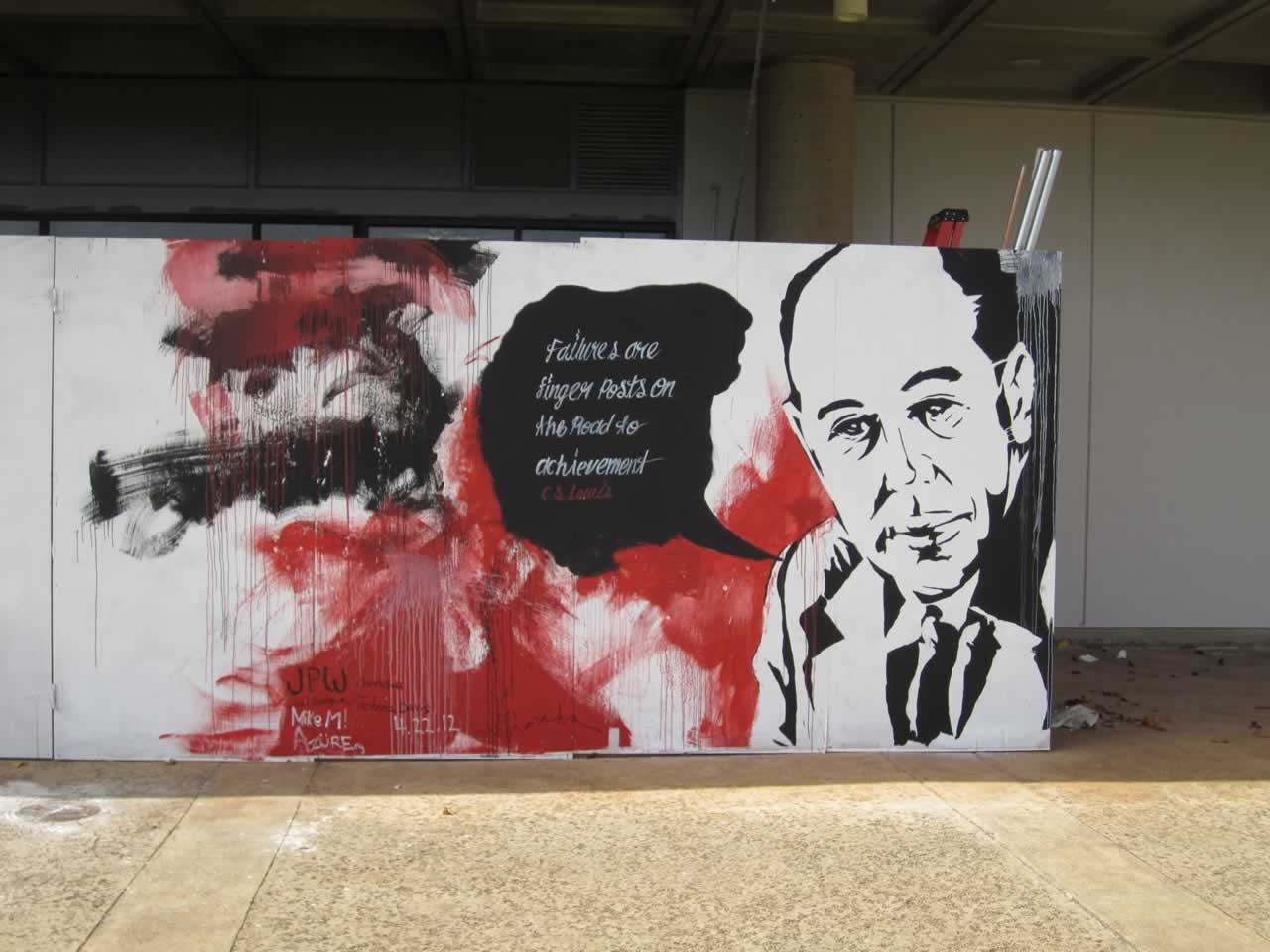
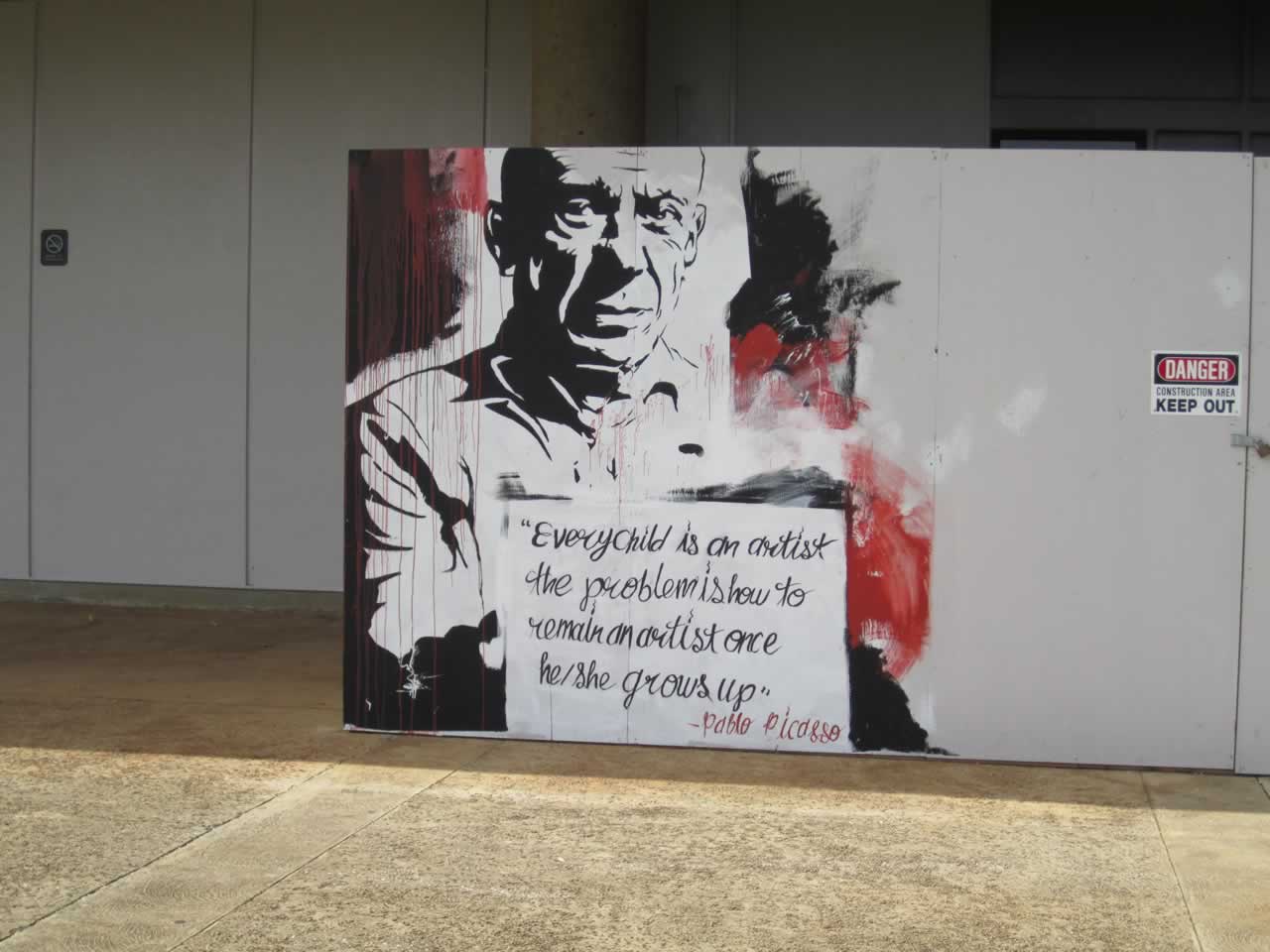
Some members of the Student Media Art Collective (SMAC) we assembled had gotten an idea to create a mural on the construction wall by the college library. At one of the SMAC meetings, they had mentioned they were having a difficult time getting past all the administrative and bureaucratic hurdles. There was a plan to paint the mural at the end of March during the school Spring Break. When it didn’t emerge, I figured the hurdles got the best of the students.

However, I liked the idea and given that construction next to my building would cause a larger construction wall to encroach upon the courtyard in front of the theatre eliminating 1/3 of it for 18 months, I saw a pressing need to make the wall attractive. I broached the subject with the appropriate powers that be last week to lay the groundwork and smooth the road. I also spoke with a couple of the professors who were advocating for the library mural project to get their buy in. Everyone was pretty positive about the idea and the professors figured my involvement would help eliminate some of the barriers the students had faced this go round.

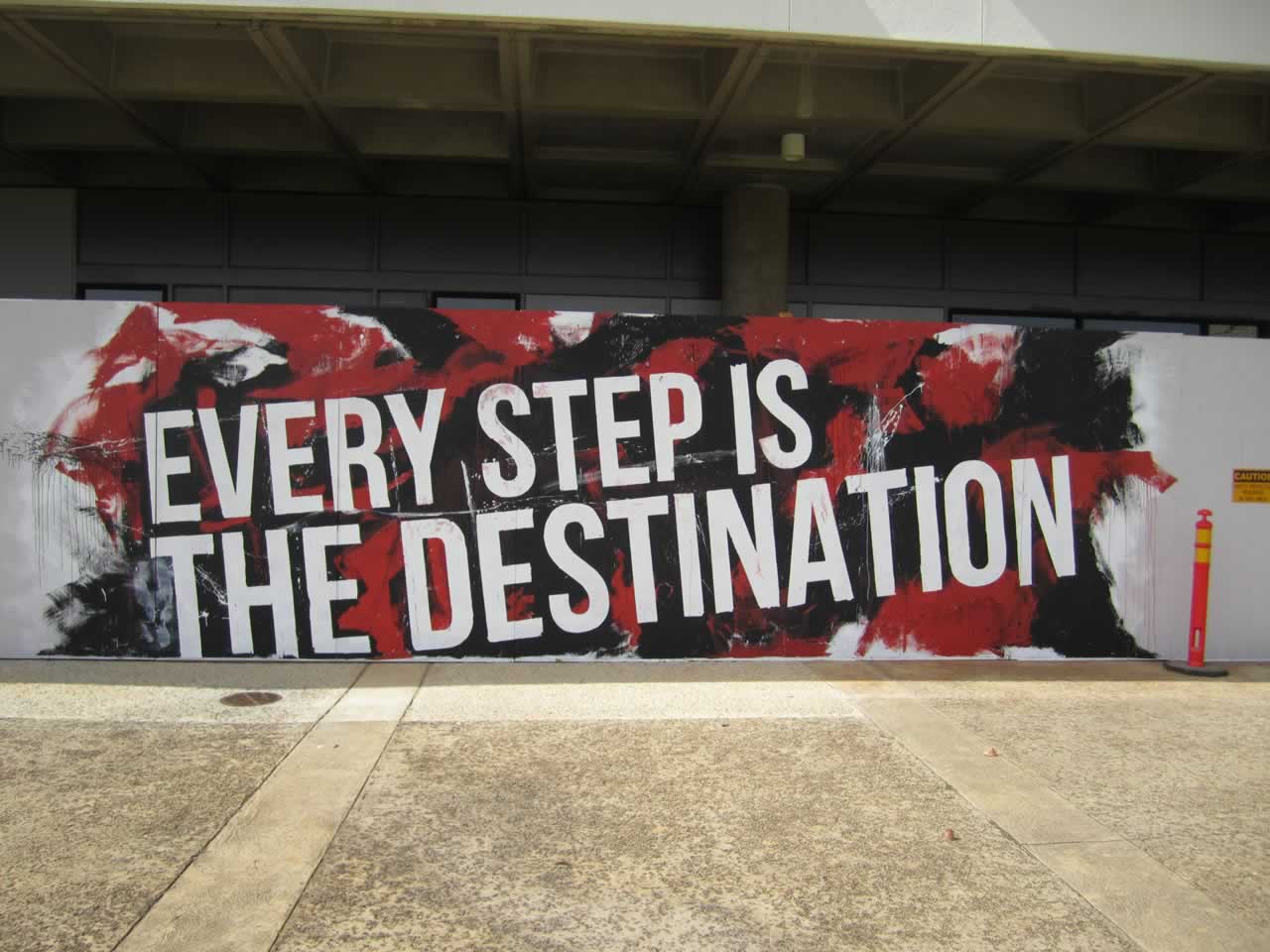
Happily, the students got the green light to do the library mural after all and worked throughout the past weekend to create it. The mural is fairly simple as you can see in the images below. However, it provides proof that the students can pull the project off within the parameters set by the various concerned parties. As much influence as I may or may not have, had they not done a good job it would have been that much more difficult to get a mural on the construction wall in front of my theatre.


I stood with to two of the visual arts professors who had been supportive of the work this morning and they were extremely pleased by so many aspects of the project. Just as I might be able to pick out various nuances in a performance, they were making observations about the execution of the piece that were not significant to me at all. (Like the way the black and white merged into each other at the bottom of the “H”.)

Amid all the gushing observations, they expressed pride in the students for pushing the project and their vision to competion despite all the obstacles. One of the group leaders wanted to give up a number of times. One professor pointed out that Christo had faced similar problems getting permission for his public art projects. Much of the professors’ pleasure probably derived from the fact that the impetus to execute the mural was generated entirely by the students rather than a class assignment. They were very happy to see students taking the initiative.

For me the mural represented an argument against those who claim there is little value for art in education. That mural required research, mathematical knowledge to execute in larger scale, politicking and advocacy, understanding the materials and media, artistic choices and team work. There was a lot of problem solving involved, which of course we all know is highly valued by employers these days.

In the middle of the project, one of the students commented that they didn’t realize how much work would be involved. The professor working with them chuckled and replied that he purposely never asked them if they realized how much work would be involved because he didn’t want to dissuade them.

This blog entry comes partially out of an email I sent out to the campus directing their attention to the decision making and problem solving required to bring the mural to fruition.  This was partially to  underscore the role of arts in the education process. I was also addressing the assumption that it was executed almost on the spur of the moment without much planning and preparation. It became apparent after speaking with a few of the people involved that concerns about a reckless execution was the basis for some of the impediments to authorization the students experienced.

Graduation is in a couple weeks and it is usually held in the library courtyard with the stage directly in front of where this wall is. This means the audience is facing the mural the whole time. I hope no one makes the decision to hide or cover it up. I think the sentiment expressed is perfect for a commencement.


Creativity To The Left Of Me, Creativity To The Right

I am just getting around to reading a piece in the Chronicle of Higher Education by Stephen Tepper and George Kuh (subscription required) about the need to get serious about teaching creativity. By coincidence or design, Americans for the Arts is holding a blog salon on arts in education that also focuses heavily on creativity. Clearly this is becoming a prime topic of discussion.

Tepper and Kuh argue against a prevailing image that creativity stems from environmental conditions rather than being developed through hard work and practice.

“First, we must move beyond the naïvely egalitarian, almost mystical view of creativity advanced by many creativity enthusiasts. This view suggests that to unleash creative capacity, we have only to set up conditions in which creativity will naturally blossom—informal workspaces, nonhierarchical organizations, flexible jobs, opportunities for cross-fertilization, and diverse and hip urban spaces. Such conditions are thought to encourage lateral thinking, brainstorming, and risk taking, all of which set the stage for innovation and entrepreneurship. No wonder creativity is an irresistible solution to our nation’s most pressing challenges! It appears to flow like tap water, requiring no significant investment in research or training. To transform our economy, we just have to get out of the way and let creativity grow free, like kudzu.

Existing research suggests otherwise. Creativity is not a mysterious quality, nor can one simply try on one of Edward de Bono’s six thinking hats to start the creative juices flowing. Rather, creativity is cultivated through rigorous training and by deliberately practicing certain core abilities and skills over an extended period of time. These include:

1. the ability to approach problems in nonroutine ways using analogy and metaphor;

2. conditional or abductive reasoning (posing “what if” propositions and reframing problems);

3. keen observation and the ability to see new and unexpected patterns;

4. the ability to risk failure by taking initiative in the face of ambiguity and uncertainty;

5. the ability to heed critical feedback to revise and improve an idea;

6. a capacity to bring people, power, and resources together to implement novel ideas; and

7. the expressive agility required to draw on multiple means (visual, oral, written, media-related) to communicate novel ideas to others.”

They admit that not all university arts programs are designed to engender these qualities, nor are the arts the sole discipline that engenders these abilities, but by and large arts students are challenged in these ways.

In the last few years I have frequently talked about how businesses are saying there is a need for creativity in leaders and employees. Other than citing other people who have said it, I haven’t had any solid evidence to back the claim up. However, thanks to a post by Emily Peck on the AftA blog salon, now I do. She links to an IBM survey of 1500 executive directors, Capitalizing on Complexity, where their top insight is that CEO’s need to:

Embody creative leadership.
CEOs now realize that creativity trumps other leadership characteristics. Creative leaders are comfortable with ambiguity and experimentation. To connect with and inspire a new generation, they lead and interact in entirely new ways.

Notice the words ambiguity and experimentation also listed by Tepper and Kuh.

Another salon blogger, Sarah Murr who works as an arts and culture subject matter expert for Boeing, cites Seven Survival Skills created by researcher and author Tony Wagner that …”people need in order to discuss, understand, and offer leadership to solve some of the most pressing issues we face as a democracy in the 21st century”

These too look very much like those listed by Tepper and Kuh which provides me some confidence that the thinking in the arts and business worlds are resonating to some degree. But there is still some work to be done in communicating these commonalities. Another arts in education salon blogger, Eric Booth, reported the general message he came away with from a National Arts Policy Roundtable retreat.

“The key message I took away from them could be stated like this:

Most people in business think “creativity” is a fluffy indefinite word, yet more hokum from the touchy-feely-artsy set. Indeed most business people do not want new employees arriving with the expectation that they can be creative all over the place. What we want are innovations, and hard-working employees who can recognize and deliver on the unusual occasion in which their creative input is valuable. If you can identify for me the key skills within creativity that produce successful employees in my real setting, and produce innovations that work for my company, and can show me the data that affirms you can reliably develop those key skills, I will become your biggest supporter. Til then, it sounds like fluff to me.

We can’t even name the key skills of creativity that we train, no less demonstrate that we reliably develop such skills.

[…]

I do meet a lot of creativity in good students of all interest areas, which makes me wonder if the arts really are delivering something distinctively potent. I even find research that affirms parts of this assertion that the arts are unusually powerful in developing creative capacity. But even if we are succeeding in developing creative capacity effectively, few can articulate what it is we are doing, or what those skills are.

How can we change the status quo if we can’t make a clear, well-founded statement about a core claim?

[…]

Identify the top three skills of creativity that matter to you in your work with career-track students. Not 10 or 23 skills, but the most essential two or three skills…

And one year from now, add a very simple and non-intrusive documentation-and-assessment practice that illuminates the ways in which your students are getting better at those skills over time. That’s it. That simple.

This may sound like a lot of work, but if you are in education you know that everything is moving toward evidence based whether it is K-12 No Child Left Behind or to meet accreditation standards in higher education. Measuring what Booth suggests should at least be marginally more interesting than performing most evaluations because you are establishing your own criteria.

Info You Can Use: Tix, Pix, Kits and Internships

I am a busy, busy boy this week which is why I ended up not posting yesterday. Hopefully things will calm down a little by next week. So by way of recompense for not posting yesterday, I offer you four links to practical information for use in your arts organization. I am sure at least one of these links will prove useful to you.

First up, Richard Kessler recently posted a toolkit for getting parents involved in arts education, Involving Parents and Schools in Arts Education: Are We There Yet? What is special about this guide is that it is written by parents for parents. Presumably, parents will know what best motivates them to get involved. As Kessler says, “You have to admit, there’s something to be said about a guide that emerges directly from the work of parents, educators, and partners, rather than from staff.”

I haven’t gotten a chance to look at the whole thing, but I am encouraged that the second chapter is “Understanding Parents” and the fifth chapter is “Motivating Parents” with the “Educating Parents” in between. In the arts I think we often want to skip past the understanding and educating parts and move straight to motivating audiences into the action of attendance. The handbook reminds us of the proper order of things. The guide is 45 pages long. Fifteen pages are devoted to interacting with parents, the other 30 odd are sample forms, checklists and templates to use in organizing parents toward a school arts event.

Next, a link from our friends at the Non-Profit Law blog to the Department of Labor’s fact sheet about what is allowed during an internship under the Fair Labor Standards Act. It should be noted that these rules only apply to for-profit businesses at the moment, but a footnote they state (my emphasis) “Unpaid internships in the public sector and for non-profit charitable organizations, where the intern volunteers without expectation of compensation, are generally permissible. WHD is reviewing the need for additional guidance on internships in the public and non-profit sectors.” So it might be prudent to design your current internship program with the for-profit guidelines in mind.

Chad Bauman talks about a plan that the Arena Stage formulated to wean people off student discounts. They used to offer $15 tickets to people under 30 during the week prior to the performance. The problem was, once they turned 31, their ticket price went up to $60. It appeared this steep price jump was discouraging people from continuing to attend.

Now their plan is to offer a “pay your age” pricing for 3% of the seats starting two months before the first performance. The hope is to not only create the idea of paying an increasing amount as you age, but also emphasize the importance of buying tickets early rather than the week of the performance.

This program is still only available to people under 30. You don’t pay $85 if you are long lived. In the comment section of the entry, Bauman addresses the potential sticker shock a person might get upon turning 31 and finding they now have to pay $60 instead of $30. I really appreciate his view of cultivating a person over 10-15 years.

“Once a patron turns 31, and we have already gotten them into a pattern of buying early for a discount, we would then offer them a 3-play preview subscription acquisition promo probably in the range of $99 for three plays (or $33 per ticket). After they “age-out,” my next major priority is getting them to subscribe. Then once they subsribe, I will work to get them to upgrade their subscription packages. This is a long term strategy that really looks at the customer over a span of 10-15 years. From first time PYA buyer to full season subscriber and donor will probably take 15 years.”

Finally, if you use images from the internet and are confused about the difference between royalty free and copyright free images or aren’t really even sure about acquiring images to use, Tentblogger has a good comprehensive guide (with supporting images, of course) dealing with all these questions and more.

Making ‘Em Want To Sing, One Seventh Grader At A Time

I spent the morning talking to 7th and 8th graders about careers in the arts. The assistant theatre manager (ATM) and I sort of tag-teamed the presentation which included slides on some of shows to help communicate the need for good skills in research, reading, writing, communication, collaboration, math, technology and dedication alongside the specific skills you need for each discipline. Since the ATM and I had different career paths that brought us to our current jobs, we talked a little bit about that while quizzing the students on their knowledge and involvement in the arts.

On the drive over today, I couldn’t help feeling I might be selling the students a flawed bill of goods. The radio was full of stories about proposals to liquidate the National Endowments and the bankruptcy of Borders bookstores. Against a backdrop of news that arts and literature were not valued in the country, are students going to believe that the arts have something to offer them? Now granted, many 7th and 8th graders don’t listen to NPR every morning, but the message is still out there, each story contributing to students’ general outlooks and attitudes.

The only bit of sunshine was a story about Portland, OR which discussed that people keep moving to Portland even though there aren’t enough jobs. What keeps drawing them there? The overall culture and atmosphere of the city, including a mention of the music scene. I knew I had heard this sentiment before so I did a Google search before sitting down to write and sure enough, I found stories from 2010, 2009 and even earlier where people talked about the lack of jobs, the cool vibe and the music scene. You can find plenty of blog entries on the subject as well. I was pleased to continually hear a story where the arts were mentioned as an attractive element of a city.

When I got to the school, we discovered we were assigned to choral room. That seemed like a good environment in which to talk about the performing arts. We spoke to the music teacher there and he told us because of the high stakes testing, they no longer had a drama program in the school. This was rather disappointing to us, of course. However, we also discovered that he has over 200 students auditioning for 65 slots in his choral classes. He said it used to be 100 students until American Idol first aired and he got a surge of interest. Then when Glee started airing, he got another surge. Now he has to turn away twice as many students as he can accept. The choral director actually used to teach band at the high school down the street from me, but moved when he started a family because he wasn’t getting home until 10:00 pm and then had to get back up at 5:00 to return to work.

Next door was the band room where the son of one of our college’s retired music professors teaches music. According to the principal, both the professor and his wife come in pretty much daily to help their son teach the class. If music gets cut in their school, (and the choral teacher is getting a masters in another subject area to hedge against that), not only will the school lose its music teachers, but the efforts of two parents as well. If the arts programs get cut from these schools, it won’t be because of lack of interest from students or lack of dedication from teachers.

This school does not serve zip codes where the education reflects the values of an affluent community either. This isn’t to suggest that the parents aren’t pushing their students to do well, merely that the school isn’t in a place where people automatically assume the students will excel and succeed based wholly on the neighborhood. I was pleased to see that the arts didn’t face an entirely uphill battle in relation to communicating the value of the arts in one’s life to their students. There were some good role models and practices in front of the students.

Americans for the Arts has set up an easy way for you to write your representatives in Congress about continuing to fund the NEA and arts education. I like the format because it is much more flexible about allowing you to mix your own thoughts with pre-written text than most email campaigns allow. I have had it bookmarked for a couple days because I didn’t really want to go with a lot of the pre-generated text, but hadn’t quite thought of a way to make what I had to say personal for my representatives. Thinking about what I saw today, I think I finally have something that will create the connection I want them to make.